Last fall, the New York City Department of Education graded each of its schools on an A-F scale. Schools were warned that those with Fs – there were 49 altogether - faced closure. Shortly thereafter, the New York City Department of Education announced its intention to close 14 schools. Somewhat perplexing was that 6 of these schools had earned Ds on their progress reports. Why would the Department of Education, we wondered, close D schools before F schools if it believed in its own Progress Report system?
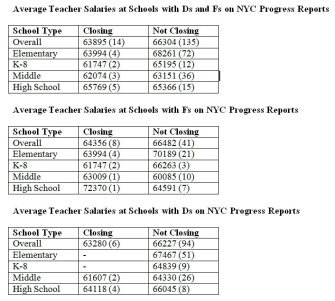
Theories abounded. A widely circulated explanation reasoned that Klein et al. were hell-bent on rooting out experienced – and thus expensive – teachers. If this was the case, closing schools should have higher average salaries than other D and F schools that are not closing.
The tables below, derived from school-based average teacher salaries, do not suggest that schools with higher average salaries are more likely to be shuttered. Below, I’ve cut the data three ways – first looking at closing and non-closing salaries for both D and F schools, and then breaking these data out separately for D and F schools. One exception is among F high schools, where the school that is closing has the highest average teacher salary. There are 7 other F high schools with salaries ranging from $57,289 to $69,154; Canarsie High School has an average teacher salary of $72,370.
But there’s something in this post for everybody. Many have speculated that the district is closing large high schools and replacing them with smaller ones, in part, to drive out experienced teachers.
What’s clear is that smaller high schools have substantially lower average teacher salaries than the larger high schools that they’re replacing. (See the graph below.) Schools with fewer than 400 students have average salaries of $61,293, while those with more than 3000 students have average salaries of $71,296. While we can’t confirm the district’s intent, the effect of closing down large high schools has been to replace experienced teachers with inexperienced ones.

* Note: The data I presented on Friday come directly from schools’ Galaxy budgets; these data are from an aggregate Fair Student Funding file, and thus the salaries reported for individual schools are not identical.