A Leonard Sax Fact Check: Are Women Worse Off in Science and Engineering Than They Were 20 Years Ago?
Leonard Sax, everyone's favorite advocate of gender-based education, has a commentary in this week's Ed Week, "Where the Girls Aren't: What the Media Missed in the AAUW's Report on Gender Equity." Here's the central argument:
"There is a real gender gap, and it’s growing rapidly, but that gap has little to do with graduation rates or college-entrance rates, parameters that are given great emphasis in the report. The real gender gap is not in ability but in motivation—not in what girls and boys can do, but in what girls and boys want to do: specifically, in what they want to learn, and how they want to learn it."
What's the evidence for his argument? "The absolute number of young women studying computer science and physics has fallen by more than 50 percent in the past 20 years. That drop may seem puzzling at first, since the past 20 years has been an era in which girls have been encouraged from kindergarten through grade 12 to be physicists, engineers, and the like," says Sax.
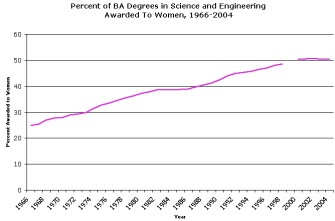
Is Sax right? Before looking specifically at physics, computer science, and engineering, let's check out trends in female BA attainment in science and engineering from 1966-2004. Over this time period, the percent of science and engineering degrees awarded to women has increased from 25% to 50%, according to data from the National Science Foundation.
But what about the "hardest sciences?" Women have made steady gains in every field over this time period. Women earn more than 60% of degrees in the biological sciences, half of the degrees in Chemistry, and almost half of the degrees in mathematics. The female share of degrees in physics, engineering, and computer science has also increased steadily over this time period. Less than 5% of degrees were awarded to women in physics and engineering in the 1960s, and now 1 in 5 degrees in these fields goes to women. (Thanks to the American Institute of Physics for the graph.)
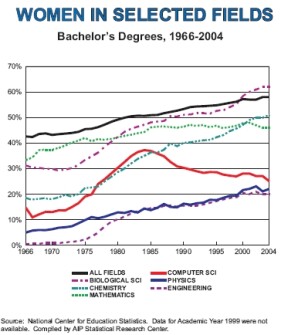
However, the female share of computer science degrees in 1985 was greater than it is in 2004. Why might that be? Things have ramped up since the Commodore 64, and the number of degrees awarded in computer science has exploded. That growth has been faster for men than women. But if you look at counts of degrees - the meat of Sax's argument - the same number of women earned CS degrees in 2004 as did at the female CS peak in 1985. (See this graph.) In short, Sax's claim does not appear to be true - the same number of women earned degrees in CS in the mid-1980s, and the female share of physics degrees has increased even as overall physics enrollments have increased.
When I contacted Dr. Sax about these data, he argued that overall degree attainment is misleading because the increase in female science and engineering degrees is driven by temporary visa holders, not US citizens. He wrote, "Neither of your graphs takes into account the NATIONALITY of the women earning the degrees. Most of the rise in the number of women earning degrees in computer science since 1999 comes from women from other countries holding temporary US visas."
As far as I can tell, the BA attainment data are not available for citizens and non-citizens before 1995. Over that time period, female US citizens and permanent residents made amazing strides in science and engineering BA attainment. Between 1995 and 2004, there was a 30% increase in the number of science and engineering BAs awarded to female US citizens, which is 2.5 times the growth for male American citizens. Let's look at different disciplines:
*The number of physics BAs grew 36% for women, 8 times the increase for men.
* In engineering, the number of degrees grew 19% for women even as it dropped 1% for men.
* The number of electrical engineering degrees grew 35% for women, 1.6 times the growth rate for men.
* In computer science, there was a 102% increase for women, which was less than the increase for men. (And per Sax's specific claim above, the number of female US citizens earning CS degrees increased 36% (from 9,569 to 12,990) between 2000-2004; it increased from 905 to 1416 (56%) for female non-US citizens.)
Sure, you can find some fields where there have not been increases for women. For example, there's been a 4% decrease in female BA attainment in mathematics. But when we look at the whole picture, rather than cherry pick one or two subfields, it's hard to see evidence here that gender-mixed math and science classes in K-12 have slowed female American citizens' rate of progress in earning science and engineering BAs.
Unsatisfied with the fact that women have made quite substantial gains at the undergraduate level in science and engineering, Sax suggested that I look at graduate school. But again, female US citizens have made enormous gains at the graduate level as well. There were 135,431 female US citizen graduate students in science and engineering in 1999 and 163,820 in 2006: a 21% increase. At the same time, the number of male US citizen graduate students in science and engineering has only increased by 8%. To be sure, the rate of increase for non-US citizen women is greater than the rate of increase for US citizens - but there is that globalization phenomenon to consider.
In sum, Leonard Sax's commentary did not provide an accurate portrait of trends in women's attainment in science and engineering. Women still have a way to go before achieving parity in computer science, physics, and engineering, but there's little evidence that gender-based education a la Sax is going to get us there.
"There is a real gender gap, and it’s growing rapidly, but that gap has little to do with graduation rates or college-entrance rates, parameters that are given great emphasis in the report. The real gender gap is not in ability but in motivation—not in what girls and boys can do, but in what girls and boys want to do: specifically, in what they want to learn, and how they want to learn it."
What's the evidence for his argument? "The absolute number of young women studying computer science and physics has fallen by more than 50 percent in the past 20 years. That drop may seem puzzling at first, since the past 20 years has been an era in which girls have been encouraged from kindergarten through grade 12 to be physicists, engineers, and the like," says Sax.
Is Sax right? Before looking specifically at physics, computer science, and engineering, let's check out trends in female BA attainment in science and engineering from 1966-2004. Over this time period, the percent of science and engineering degrees awarded to women has increased from 25% to 50%, according to data from the National Science Foundation.

But what about the "hardest sciences?" Women have made steady gains in every field over this time period. Women earn more than 60% of degrees in the biological sciences, half of the degrees in Chemistry, and almost half of the degrees in mathematics. The female share of degrees in physics, engineering, and computer science has also increased steadily over this time period. Less than 5% of degrees were awarded to women in physics and engineering in the 1960s, and now 1 in 5 degrees in these fields goes to women. (Thanks to the American Institute of Physics for the graph.)

However, the female share of computer science degrees in 1985 was greater than it is in 2004. Why might that be? Things have ramped up since the Commodore 64, and the number of degrees awarded in computer science has exploded. That growth has been faster for men than women. But if you look at counts of degrees - the meat of Sax's argument - the same number of women earned CS degrees in 2004 as did at the female CS peak in 1985. (See this graph.) In short, Sax's claim does not appear to be true - the same number of women earned degrees in CS in the mid-1980s, and the female share of physics degrees has increased even as overall physics enrollments have increased.
When I contacted Dr. Sax about these data, he argued that overall degree attainment is misleading because the increase in female science and engineering degrees is driven by temporary visa holders, not US citizens. He wrote, "Neither of your graphs takes into account the NATIONALITY of the women earning the degrees. Most of the rise in the number of women earning degrees in computer science since 1999 comes from women from other countries holding temporary US visas."
As far as I can tell, the BA attainment data are not available for citizens and non-citizens before 1995. Over that time period, female US citizens and permanent residents made amazing strides in science and engineering BA attainment. Between 1995 and 2004, there was a 30% increase in the number of science and engineering BAs awarded to female US citizens, which is 2.5 times the growth for male American citizens. Let's look at different disciplines:
*The number of physics BAs grew 36% for women, 8 times the increase for men.
* In engineering, the number of degrees grew 19% for women even as it dropped 1% for men.
* The number of electrical engineering degrees grew 35% for women, 1.6 times the growth rate for men.
* In computer science, there was a 102% increase for women, which was less than the increase for men. (And per Sax's specific claim above, the number of female US citizens earning CS degrees increased 36% (from 9,569 to 12,990) between 2000-2004; it increased from 905 to 1416 (56%) for female non-US citizens.)
Sure, you can find some fields where there have not been increases for women. For example, there's been a 4% decrease in female BA attainment in mathematics. But when we look at the whole picture, rather than cherry pick one or two subfields, it's hard to see evidence here that gender-mixed math and science classes in K-12 have slowed female American citizens' rate of progress in earning science and engineering BAs.
Unsatisfied with the fact that women have made quite substantial gains at the undergraduate level in science and engineering, Sax suggested that I look at graduate school. But again, female US citizens have made enormous gains at the graduate level as well. There were 135,431 female US citizen graduate students in science and engineering in 1999 and 163,820 in 2006: a 21% increase. At the same time, the number of male US citizen graduate students in science and engineering has only increased by 8%. To be sure, the rate of increase for non-US citizen women is greater than the rate of increase for US citizens - but there is that globalization phenomenon to consider.
In sum, Leonard Sax's commentary did not provide an accurate portrait of trends in women's attainment in science and engineering. Women still have a way to go before achieving parity in computer science, physics, and engineering, but there's little evidence that gender-based education a la Sax is going to get us there.


Comments
Thanks for digging into this. I read Sax's article and had a hard time reconciling his numbers with what I see around me.
I received a physics BA in 1978 and a physics PhD in 1984 and currently teach undergraduates. At least in my institution there are a LOT more women doing physics both as undergraduates and graduate students than was my experience 25 years ago.
Posted by: Rachel | June 17, 2008 4:00 PM
In 1986, 15,126 women in the United States earned a bachelor's degree in computer science. By 1998, the number was down to 7,439 -- more than a 50% reduction. These numbers come from the National Science Foundation: the link is http://www.nsf.gov/statistics/nsf07307/pdf/tab34.pdf.
In the past five years, the numbers have recovered significantly (although they still have not yet returned to 1986 levels); and, some of that growth appears to be due to women from other countries with temporary visas.
Posted by: Leonard Sax | June 17, 2008 9:15 PM
Hi Dr. Sax,
Thanks for the link to that file. For other readers, the CS BA degrees awarded to women in 1986 were 15126; in 2004 the number was 14,406. Between 1995 and 2004, there was a 102% increase in CS BA attainment for American citizens.
If the problem is about science education for women, how would you explain that CS degree attainment also declines significantly for men over this time period?
1986: 27,069
1990: 19,321
1995: 17,706
1996: 17,773
1997: 18,490
1998: 20,235
Posted by: eduwonkette | June 17, 2008 9:28 PM
I followed the link Dr. Sax gave, and before I found the CS statistics, I found a listing of the total science and engineering degrees (bachelors, masters, PhDs) broken down by year (from 1966-2004) and by sex.
For each level of degree, there is a steady rise in the percentage given to women over the 35 year period, from 24.8% in 1966 to 50.4% in 2004. During that time the absolute number of women earing science and engineering bachelors increased by more than a factor of 5, from 45,634 in 1966, to 229,412 in 2004.
Much of this growth may be attributable to the biological sciences, so I dug a bit further and looked at the statistics for engineering degrees. The total numbers are smaller, but the growth is even more dramatic. In 1966, 146 engineering bachelors were awarded to women, 0.4% of the total; in 2004, 13,257 engineering bachelors were awarded to women, more than 20% of the total.
There are certainly still challenges for women in science, and looking for more ways of interesting young women in science is important. But the scientist in me believes it in looking at data for insights, and not mining it selectively for talking points.
Posted by: Rachel | June 18, 2008 12:37 AM
Oops: In my comment above "from 24.8% in 1966 to 50.4% in 2004" refers to bachelors in science and engineering. There was a similar steady increase in the fraction of women earning masters and PhDs: in 1966, women earned 13.3% of science and engineering masters and 8.0% of science and engineering PhDs, in 2004 the respective numbers were 43.6% and 37.4%.
Posted by: Rachel | June 18, 2008 2:20 AM
So... one of them graduated?
Posted by: web design company | June 18, 2008 6:03 PM
Eduwonkette's blog appears to boil down to a semantic quibble, missing the forest for the trees. Sax states that the number of women studying computer science and physics "has fallen by more than 50 percent in the past 20 years." Eduwonkette interprets that to mean that the number of women studying computer science in 2008 must be at least 50% lower than in 1988, which is not the case. In fact, Sax should have said: "the number of women earning college degrees in computer science fell by more than 50 percent between 1987 and 2000, but has recovered significantly since that time."
Eduwonkette does not dispute Sax's central point, which is that there is a substantial gender gap in choice of subjects. For example, Sax states that "more than 80 percent of students who take the AP Spanish exam are girls, while more than 75 percent of students taking the physics AP exam are boys." Eduwonkette does not contest this point, which is central to Sax's claim that the education community in general, and the AAUW in particular, are ignoring the question of WHY girls and boys continue to choose to study such different subjects, despite decades of preaching about gender equity.
Posted by: LouV | June 29, 2008 10:11 PM
As an aspiring teacher... but why does everyone talk about women in engineering, but we don't talk about men in Elementary teaching, men in nursing, etc... Is it more important to have women engineers and programmers than to have men elementary school teachers and male nurses?
Posted by: rory | August 19, 2008 10:51 PM
The point is well explained in "Boys Adrift". The comparison must be made with boys for those same periods: It is not so much that girls are better off in science, they account for a larger percentage only inasmuch are boys' percentages have dropped due to school desertion.
Posted by: V. | September 21, 2008 12:03 PM