May 17, 2013

CEOs Want Hard-Working, Decision-Making Team Players

A survey of chief executives indicates that 92% say education is very or the most important national competitiveness issue.  But the survey, conducted by the The Business Council and The Conference Board, isn't a flattering picture of U.S. education. Three quarters of the CEOs think U.S. higher education is better/much better than competitors; but only 23% and 14%, respectively, say the same about U.S. secondary and primary education.

What's most important? The priority on soft skills (what Conley calls metacognative skills) is clear.  Interestingly, work ethic is the clear winner.  The next four priorities describe the setting--teamwork, decision making, critical thinking, and computer literacy.  The 3Rs come next on the priority list.

Views about schools are shaped by the fact that about half of the CEOs say they are having trouble finding qualified workers.  While CEOs don't have much regard for U.S. primary schools, they do rate the U.S. workforce high on creativity and motivation to advance--they picked that up somewhere.  In addition to weak writing and communication skills, the CEOs are worried about the physical and health readiness of the workforce--the first time I've seen that on a survey.

Tony Wagner outlined the 7 survival skills in the Global Achievement Gap--they line up pretty well with the surveyed CEO priorities.  As noted in his most recent book, Creating Innovators, he sees a mismatch between what is taught/tested and what is required by the new economy.  Wagner suggests the skills required for work, learning, and citizenship have converged. "Schools aren't failing and don't need reform," instead says Wagner, "we need to reinvent, re-imagine our schools."

There are five fundamental mismatches, according to Wagner, between the structure of schools and the culture of innovation:


  1. The culture of learning is about individual assessment and sorting, but innovation is a team sport;

  2. The culture of schooling is compartmentalized, but innovation happens at the boundary between disciplines;

  3. Most schools exhibit a culture of infantilization and passivity; by contrast innovators are active creators;

  4. The culture of school rewards risk aversion and penalizes failure; the culture of innovation demands risk and iteration; and

  5. Schools rely on extrinsic motivation, innovators are usually motivated intrinsically.


Wagner boils down the basic principles of creating innovators to play, passion and purpose.  Wagner is fond of High Tech High where founder Larry Rosenstock talks about how the best in any field are always perplexed by new problems. Rosenstock wants to inculcate perplexity.

"We need a new accountability system starting with the skills that matter most," said Wagner. He wants performance standards not content standards (i.e., write an effective essay versus find a gerund in a passage).  Wagner wants digital portfolios so kids can show what they know and a merit badge system where they progress based on demonstrated mastery.


May 13, 2013

Smart Cities: Viva Las Vegas

"Education is the bedrock on which a truly great city is built," according to Tony Hsieh and his Downtown Project. The CEO of shopping giant Zappos is leading efforts to reimagine the old city center north of the Vegas Strip. It's one of several promising efforts to reverse the economic freefall that started in 2008 and create a vibrant dense urban core and "the most community-focused large city in the world."

I spent last week in Las Vegas at the invitation of The Public Education Foundation, a nonprofit that brings together business and community leaders who support smart, bold initiatives to improve public schools. While the challenges are great (and somewhat unique), there are several positive vectors that allow optimists and outsiders to imagine something great.

It was Edward L. Glaeser's Triumph of the City that convinced Hsieh to transform downtown Las Vegas into a dynamic urban center. The Glaeser formula calls for "at least 100 people per acre combined with ground-level gathering places such as cafes, interesting small businesses, and public spaces."

Zappos will be moving into the old city hall building with a model that's more NYU than Google--where you don't quite know where the headquarters ends and the community begins.

An explosion of activity encompassing art, culture, business formation, and new school development are now part of a $350 million five year project. Without visiting, "it's hard to really grok what's happening there -- the scope of the project is so grand and its aims are pretty ambitious," said TechCrunch.

Downtown Project encourages learning and creativity by hosting First Friday, a monthly arts festival--imagine Coachella, Burning Man, and TED in streets of Las Vegas. There is also a tech week, a fashion week, and Catalyst Week--an exploration of strategic partnerships in philanthropy, wellness, music, fashion, education, and technology. The Downtown Speaker Series brings several thought-provoking TED style speakers to town every week. They talk in a packed double-wide but will soon light up Inspire Theater.

The Downtown Project includes a $50 million small business investment fund. Criteria

include passion, contribution to the community, ability to execute, self sustainable, and a

unique story. There is also a $50 million education budget. Former Wall Street trader Connie Yeh leads the education efforts including the development of a new school.

Laying the Foundation. The Public Education Foundation develops great school leaders. They host several leadership summits each year focused on strategic thinking, solution driven innovation, and performance-based decision making.

Their Executive Leadership Academy is a 15 month intensive development opportunity for experienced education and business leaders committed to transforming public education. Last week, the Getting Smart team facilitated a two-day blended school design workshop where participants prepared two mini-lessons on blended components and created plans for a new or conversion K-8 school and a high school. (Every community should run a design session like this for school leaders given emerging blended learning opportunities).

The foundation also runs college scholarship, teacher support, reading, and volunteer programs.

Cool Schools. Started in 2009, the Las Vegas Math Initiative is a community partnership to help teachers elevate student math achievement with a target impact of 15,000 students in 27 schools. The six year initiative of MIND Research Institute provides schools with K-5 visual based math program ST Math, training and support for teachers and administrators.

I visited Jeffers Elementary to see a tablet deployment of ST Math. Over 120 of the 150 new kindergarteners spoke no English on the first day of school, with a similar percentage of students living in or near poverty. While the school is close to 1:1 access, it's a hodge podge of old desktops, laptops, and tablets (making it a challenge to administer an online writing assessment, for example). Teachers like Daniel Cano (a Rookie Teacher of the Year last year) align ST Math games with Investigations , their core curriculum, and make the most of mixed forms of access with a classroom rotation model that gives him time to work with small groups of struggling students.

Across the street is Von Tobel Middle School, one of five middle schools in the county piloting 1:1 iPads as part of the Engage, Empower, Explore Project (E3). Principal Roger Gonzalez is participating in the Executive Leadership Academy.

"To see the structural change over the year has been amazing," said district CTO Jhone Ebert about an e3 classroom visit last week. "Within 20 seconds the students were on their iPads taking a quiz in Edmodo. They then broke up into groups to work on a caste system presentation. Students were allowed to work in the hallway on their projects. As I walked around and spoke to all of the students they could not imagine going back to a learning environment without this tool.

The Clark County School District (CCSD) has a well developed network of magnet schools. I had the opportunity to learn from and with two of the principals last week from:

  • Walter Bracken STEAM Academy --a 51 year old elementary facility rejuvenated by murals, raised beds, trees, a turtle park and mini-amphitheater--is led by award winning principal Katie Decker, an energetic and insightful educator. Grade level teams make use of a wide range of digital tools. (Watch for an upcoming feature on Bracken from Alison Anderson.)
  • Southwest Career and Technical Academy is a high school, led by Felicia Nemcek, with eleven areas of study that include "rigorous coursework, hands-on projects, job-shadowing, and internships." It makes me smile to see a high school principal with a PBL sticker (from BIE.org) on her Air. Southwest is high tech--recognized as an Apple Distinguished School two years in a row--and, Ebert noted, "The entire student body understands what it means to be a community." For example, "The fashion design students not only sew clothes for students in need but they teach low income parents this skill as well."

Nevada has 13 state approved district online programs--the largest being CCSD Virtual High School--and seven online charter schools includingNevada Connections Academy and Nevada Virtual Academy.

Clark County scored a middle-of-the-pack C- on the Brookings Choice Index reflecting a well developed magnet program but lack of charters.

CCSD has a number of schools that benefited from federal School Improvement Grants.

Hancock Elementary is a turnaround school that fulfilled grant expectations (see Sun story). "Technology is used to personalize instruction and meet the needs of ALL students," said Ebert. And, "Leadership matters!"

Former superintendent Dwight Jones said Ebert "has been nothing short of amazing in her efforts," to get 100,000 students online or in a blended environment. "She finds ways to work with staff, lead in training and manage short funding to make our goal a reality for thousands of students."

Transitions. Mr. Jones resigned as superintendent a few months ago and the board appointed Pat Skorkowsky interim. He's a good guy but it suggests the district will be in limbo for months. Some insiders would like to see Skorkowsky made permanent with board supported effort to build a strong management team.

One positive sign of continued progress on the blended front is that CCSD announced last week that it was joining other large districts in an initiative based on five Reach Extension Principles and supported by Public Impact. "Out of the 18,000 teachers in our district, we know we have so many who could have a greater impact on student achievement," says Staci Vesneske, chief human resources officer. "We just need to create opportunities for them to do so."

In an unusual relationship, the district runs the PBS station. The spectacular Vegas PBS campus also houses Educational Media Services (EMS), Vegas Virtual Online Education and CCSD's Virtual High School.

Wynning Orgs. I asked Elaine Wynn what was making a difference in the valley and she said, "Teach for America and Communities In Schools." TFA Vegas, led by Victor Wakefield, has 170 crew members this year. Wynn and Hsieh are big TFA supporters.

CIS works with schools to create a web of support for students and families. By incorporating CIS' evidence-based work into the overall school improvement strategy, teachers are freed up to create powerful learning experiences and students show up ready to learn. (CIS will be featured in SSIR's What Works in Education this week.) Wynn chairs the national CIS board and is a CIS Nevada board member.

Conclusions. Clark County schools serve a large and very challenging population with relatively low levels of funding. The school district is a member of the Portfolio School District Network but it doesn't appear to have fully embraced strong accountability, school autonomy, and multiple providers.

Nevada gets a D on the Digital Learning Now! Report Card. CER criticizes a "restrictive charter law," but notes that, "Parents do enjoy access to user-friendly data and access to digital learning opportunities is growing."

Last week I noted how universities drive innovation in Pittsburgh--there's not much evidence of that in Vegas where there is innovation infrastructure for tourism but not technology or learning--the Downtown Project is an encouraging project that could help create a new innovation infrastructure.

Last week, Las Vegas Weekly suggested that given the level of challenge Clark County could be a great place to innovate--I agree. This Smart Cities series has begun to outline the path forward. Vegas leaders need to:

  1. Study how Mind Trust Developed The Smart Cities Formula,
  2. Work with CRPE to better implement the 7 components of a portfolio strategy,
  3. Build autonomous networks around successful magnets like Bracken and Southwest,
  4. Create a blended learning funder and assistance provider like Silicon Schools to accelerate and improve Ebert's goal of 100 blended schools in three years,
  5. Add a Tech Center, like Baltimore's Digital Harbor Foundation, to the plans of the Downtown Project,
  6. Import a couple great blended networks like Summit, Rocketship, and Carpe Diem,
  7. Build a great innovation incubator like 4.0 Schools in NOLA,
  8. Join the League of Innovative Schools to leverage smart demand,
  9. Expand human capital efforts of Public Education Foundation (PEF) and TFA,
  10. Wrap schools in a web of support with CIS,
  11. Boost access to postsecondary with innovative dual enrollment options, and
  12. PEF should join the CEE-Trust network to explore ways to accelerate all of the above.


The Downtown Project is the most interesting and eclectic urban development project I've encountered. Connecting it to the districts blended learning plans and supercharging it with an innovation infrastructure could change the course of Clark County.

May 08, 2013

Study Confirms Gains From Game-Based ST Math

A WestEd study released this week confirmed gains tracked by schools using the innovative ST Math program from MIND Research Institute. More than 1,700 schools use the supplemental math games.


While MIND Research carefully tracks results from all schools, the WestEd study only considered 45 schools in Los Angeles. The study showed that ST Math made a statistically significant impact on student math performance across 45 high-need low-performing LAUSD elementary schools based on an increased percentage of students scoring proficient and advanced on the California Standards Test (CST) in 2011. The effect size of 0.41 was well beyond the What Works Clearinghouse criteria of 0.25 for "substantively important" effect.


The study confirms the approach MIND Research uses to analyze large cohorts of 10 or more schools--and there are 20 similar comparisons from Baltimore, Chicago, Houston, Las Vegas, Minneapolis, New York, Orlando, Philadelphia, Seattle and Washington, D.C. ST Math is used by more than 500,000 students in 30 states.


The LA schools gained access to ST Math through the Los Angeles Math Initiative, supported by Verizon, Boeing, Hyundai, Capital Group, the Whitman-Harsh Family Foundation, the Leonetti/O'Connell Family Foundation and more. The Seaver Institute provided initial funding for this research study.


The Santa Ana Unified School District, south of Los Angeles, provides another dramatic example of longitudinal results achieved by schools using ST Math. SAUSD, a high poverty, high ELL district, effectively closed the achievement gap by moving from 35% proficiency in math to the state average of 67% after introducing ST Math.


Many elementary schools are trying out digital math content--it's often not aligned to the core instructional program. MIND Research links ST Math to classroom instruction providing extension, application, and critical thinking opportunities. Implemented with fidelity, the blended approach is a highly effective strategy for boosting achievement.


ST Math runs on iPads. In fact, co-founder Matthew Peterson's team rewrote more than 900 games to fully take advantage of touch. They've now set their sites on the college gateway course--Algebra--and are building a highly interactive core curriculum.


Dr. Peterson believes that, "There is a clear path to get every student proficient in math and we're going to make it happen!" The WestEd study suggests they are on the right path.


Disclosure: MIND Research is a Getting Smart Advocacy Partner

May 07, 2013

Improving Teacher Conditions & Careers

Tom Vander Ark & Carri Schneider


As the nation celebrates National Teacher Appreciation Week, we couldn't think of a better way to honor National Teacher Day than with a paper that highlights the positive impacts that blended learning is having on the teaching profession.


Today Digital Learning Now! (DLN), a national campaign supported by ExcelinEd, released the seventh white paper in the DLN Smart Series -- "Improving Conditions & Careers: How Blended Learning Can Improve the Teaching Profession."


The paper brings together Smart Series authors from DLN and Getting Smart with co-authors Bryan and Emily Hassel of Public Impact. Their work on leveraging great teaching with technology and creating an Opportunity Culture in schools has accelerated and improved the development of new school models over the last thirty months.


Blended learning environments allow teachers to work in teams, support new teachers, expand collaboration time, provide personalized professional development, and expanded leadership opportunities.


The goal with the paper is to inform educators, leaders, stakeholders and policymakers about the potential of blended learning to offer better teaching conditions and enable better career opportunities, while confronting current misconceptions about teaching and technology.


In what couldn't be better timing, this week the NEA released a Policy Statement on Digital Learning that shows alignment with the paper's goals:


"NEA believes that the increasing use of technology in the classroom will transform the role of educators allowing the educational process to become ever more student centered. This latest transformation is not novel, but part of the continuing evolution of our education system. Educators, as professionals working in the best interests of their students, will continue to adjust and adapt their instructional practice and use of digital technology/tools to meet the needs and enhance the learning of their students."


It's exciting to see the NEA formally recognize what so many teachers in the field are already experiencing about the positive impact blended learning can have on the profession.


With teacher satisfaction at its lowest point in 25 years according to the most recent MetLife Survey of the American Teacher, and increased demands on teachers from the implementation of college and career readiness standards and online assessments, there has never been a better time to explore ways to improve the lives of teachers.


The paper makes the case that the shift to personalized, blended learning will yield extended time with students, more team-teaching and collaboration, new options to teach at home, a greater focus on deeper learning, individualized professional development plans, better student data to inform instruction, and more earning power.


"If blended learning lets great teachers help more students, develop peers, and earn far more, they will show us the way to make digital learning outstanding," said Bryan C. Hassel, Co-Director of Public Impact. "Even very small amounts of digital learning make job-embedded development, expanded impact, and much higher pay possible."


The paper features an overview of the teaching profession in transition, including the current demands on teachers and the redefined teacher roles that the shift to personalized learning necessitates. In a discussion of the improved teaching conditions that blended learning affords, we detail differentiated staffing and improved opportunities for collaboration and professional development. The section on improved career opportunities and pay builds on the work of Public Impact and DLN to review the opportunities to earn more within current budgets and the creation of policies to support better opportunities for teachers.


For more information, check out the full paper "Improving Conditions & Careers: How Blended Learning Can Improve the Teaching Profession" and the accompanying infographic " Blended Learning & The Teaching Profession."

May 06, 2013

Pittsburgh: An EdTech Hive

My first job out of college took me to the coalfields of southwestern Pennsylvania. Pittsburgh was just starting to rebound from the loss of thousands of steel jobs. The universities played a pivotal role in the development of a new economy based on technology, finance, and health jobs. In the last decade city--driven particularly by Carnegie Mellon University-- Pittsburgh has become an edtech hive.

Last year, Pittsburgh Today ran a six part series on building the entrepreneurial economy. The series quoted a Mellon Foundation report, "Pittsburgh is on the verge of reaching a critical mass in terms of the number of successful start-up companies, entrepreneurs, availability of local early stage capital and ability to push and pull university technologies to market."

Maker Hive. The MacArthur Foundation selected Pittsburgh as the third city to host a Hive Learning Network (along with NYC and Chicago). Hive Pittsburgh launched on Friday with a three month summer learning initiative. Hive Days of Summer activities will turn city sites into a "maker" camp for teens. The three month initiative launched Friday. Summer activities will turn city sites into a "maker" camp for teens.

Hive Pittsburgh is just one of many innovative learning initiatives happening in Pittsburgh. Tweens and teens have access to maker learning in MakeShop, STEAM learning at Assemble, on-line literacy games at community libraries, multimedia training at the LABS at the Carnegie Libraries, a Robotics Academy at Carnegie Mellon University, and even music remixing at Hip Hop on LOCK.

TechShop , a big maker success from Menlo Park ( featured on Bloomberg last week), recently opened a new location in Pittsburgh's Bakery Square.

There's also been a recent building boom of digital and maker learning spaces in public schools across the region:

And it doesn't just end with students. The Allegheny Intermediate Unit is transforming professional development with TransformeED - a digital playground for teachers to provide inspiration of how they can bring technology and maker practices into the classroom. And parents can get support through organizations ranging from the Fred Rogers Center to WQED Multimedia.

Pittsburgh educators, innovators and organizations have come together to form the Kids+Creativity Network - more than 100 organizations, including public school districts, non-profit groups, libraries, museums, afterschool programs and neighborhood community centers - which is committed to "remaking learning" in the greater Pittsburgh area. Check out more of their programs and initiatives at RemakeLearning.org.

UTech. CMU has been an edtech hotbed for more than two decades. The Human Computer Interface Institute (HCII) has a handful of interesting learning research projects underway. With the goal of designing the future of edtech, CMU recently launched a Masters in Learning Science and Engineering.

Founded by CMU cognitive and computer scientists, Carnegie Learning is a leader in secondary math software. The Apollo Group acquired Carnegie Learning for $75 million in 2011.

Two weeks ago, the Oracle and Curriki announced an effort to make CMU's Alice software widely available to secondary school teachers and students. " Getting Started with Java Using Alice" helps students learn basic concepts of Java.

CMU is home to the Eberly Center for Teaching Excellence, Language Technologies Institute, and the OLI (Open Learning Initiative).

Elijah Mayfield developed the LightSIDE writing scoring engine as a grad student at CMU. His open engine scored high in last year's Automated Student Assessment Prize ( see case study).

Luis Tandalla, the college kid from Ecuador that won $50,000 in the second Hewlett funded assessment scoring prize, is headed to CMU for his master's degree. (I saw Andrew Ng, co-founder of Coursera last week and told him that all three winners of the ASAP prize had taken his MOOC and the course was Tandalla's introduction to machine learning.)

Pitt's Learning Research & Development Center was the source of the IP for SWoRD, a peer review writing assessment system that removes bias and is marketed byPanther Learning. Pitt is also home to Lauren Resnick's Institute for Learning.

The Osher Lifelong Learning Institute offers daytime classes to seniors.

More EdTech. Think Through Math , formerly Apangea Learning, provides one-on-one math tutoring with live, online certified teachers.

Consulting giant Accenture acquired Pittsburgh-based training and development shop Maynard in 2007 and created Accenture Academy, a blended learning solution serving over 100 clients in 140 countries.

Duolingo is a language learning site that uses gamification and crowdsourcing to translate the web.

Saxifrage School is an alternative to colleges for vocational careers which has gotten some traction.

OnHand Schools , which manages large sets of student data, letting teachers drill down to the student level to cater to individual learning needs.

Fitwits is "an obesity prevention and health literacy research project that uses games and character-driven narratives to transform unhealthy lifestyles into healthy ones."

According to Mayfield, "There are always people trying to build new ed tech startups, places like Fitwits (obesity prevention), Geknowm, and a dozen other little 2-person companies."

Startups. In April Startup Weekend Pittsburgh saw more than 100 people participating in the third signature startup event. Winners from the last few Pittsburgh startups have formed companies, hired staff and even gone through accelerator programs.

Deep Dive. In 2009, the Gates Foundation awarded a $40 million grant to Pittsburgh Public Schools to implement the Empowering Effective Teachers plan. The Post Gazette said, "the district's plan would put faculty members on performance pay, give extra pay to those tackling especially important assignments, establish a teachers academy, overhaul the tenure system, broaden recruitment efforts and take steps to improve discipline in schools." The teacher evaluation system incorporates multiple measures including classroom observations, student feedback, and student achievement.

Pittsburgh is a great example of universities being a source of learning innovation.

Thanks to Lindsay Hyman for her inspiration and contributions to this post. Elijah Mayfield, Gary Gardiner, Mark Limbach, Letitia Green, Sean Bengry, Kemi Jona, and Patti Walker also contributed.

May 03, 2013

District Guide to Online Learning

Online learning can expand student (and staff) options, grow enrollment, and power blended learning. It shares many critical success factors with traditional education, but different enough that you need to do your homework and develop a good plan. Following is a 10 point district/network guide to online learning.

1. Clarify goals. You may want to:

  • Expand advanced options including AP, dual enrollment;
  • Add hard to staff courses;
  • Remain competitive in a multi-provider environment; and
  • Boost enrollment/revenue.

2. Get to know state policy.

3. Get/hire experienced help. Like traditional delivery, quality online starts with great teaching. However, offering a full catalog of online courses involves a range of new and different issues. Hire someone with experience to lead the program. Post a job on Obeekaybee.com (see Getting Smart feature).

4. Consider a partner. There are a handful of high capacity national partners that can provide turnkey support to an online learning program including:Apex, Connections, K12, and Florida Virtual. They all have experience helping districts implement online learning programs.

5. Pick a platform and content. If you don't rely on a partner, you'll need to pick a learning management system and content. There are a couple learning management systems (LMS) that come with content including Flipswitch, Vschoolz, and iQuity--and they all have experience running an online school.

6. Leverage online capacity to blend traditional schools. You may be able to use the LMS and the catalog of content to power 6-12 blended classrooms. AdvancePath

and Cornerstone Charter Schools use Apex content to power blended high school classrooms. Michigan's EEA uses Compass Odyssey across its 12 school network. (See What's All The Buzz About Detroit?)

7. Staffing. For the subjects where you can generate more than 150 enrollments and where you have or can find the people, you can staff course delivery yourself. In harder to staff and smaller demand classes, rely on your partner to staff the class.

You may want to consider moving all your small upper division AP courses online and adding the rest of the AP courses to the catalog. This is also a chance to add more foreign languages options. This may be an opportunity to save money, add options, and invest in important 9th and 10th grade classes.

8. Provide guidance on self-blends. Now that you can offer a broader course catalog, it's important to provide guidance to students starting in eighth grade about online high school options.

Consider making an online class a graduation requirement. Most students will be learning online when they leave high school whether it's in the military, corporate training, or college.

9. Marketing. You'll probably be competing regionally for students so you'll need to develop a marketing and recruiting strategy (inside and outside the district) to build enrollment. What makes your offering distinctive? Can you offer onsite support--scheduled and drop in?

10. Budget. Now it's time to build a budget. You'll need at least six months to plan, hire and train staff; and do some marketing. Be prepared to lose money for a year if enrollment doesn't meet your expectations. Working with a national partner is a good way to share the enrollment risk and development cost.

If you're still interested in starting an online learning program, the next step is iNACOL's How to Start an Online Learning Program.

Disclosures: Digital Learning Now!, K12, Connections, Florida Virtual, and Compass Learning are Getting Smart Advocacy Partners. Advanced Path is a Learn Capital portfolio company where Tom is partner. Tom is a director of iNACOL.

May 01, 2013

Nexus Lansing: A New High School Experience

Students come from nine cities to what was a dental billing office in an office park southeast Lansing. The bright open flexible space is high school for 95 students--with room for three times that many next year.

Principal Charlie Carver was an elementary administrator last year. Before that he taught for two years in a Big Picture school--great preparation for the non-traditional Nexus setting.

Nexus is a network of five flex blend high schools powered by Connections Learning, sister company to Connections Academy--a leading national network of virtual schools.

Three months after they opened in September we posted a review of the Nexus flex plus model.  At least two more will open in September. Mickey Revenaugh, a Connections founder (and fellow iNACOL board member), led a tour yesterday to the Lansing school for alternative and blended learning operators and advocates.

"Kids don't care at my old school," said Randi, a freshman. She got distracted early in the year fell behind.  Her mother helped locate Nexus Lansing.  She enrolled midyear and is now doing extra work on Saturdays to catch up. About her new school, Randi said, "They motivate you...I learn more...education is better."

"The biggest change for teachers is that we can't teach to the class because the school is self paced," said Lindsay Penny, an English teacher. MAP scores are used to place and group students.  The scheduler (who lives in Denver) sends students to one or two live sessions a week in both math and English with the onsite teachers. "We are very individualized," said Penny.

Asked if she could you ever go back to a big school, a student named McCala said, "Never.  She said, "Here I can get help when I need it."  She added, "At my old school people thought I was stuck up because I never talked.  Here I talk all the time!"

The school meets in two shifts.  The morning session runs 8:30-12:30 and the afternoon runs 1-5 pm.  Students do at least two hours of work outside of school and have time for work, internships, and extracurricular activities. "The best and the worst thing about this school is going at your own pace," said McKinsey, "if you get too far behind it's hard to catch up.

McCala said the best thing about her new school is the availability of teachers, "The Success Coaches help you stay on track."  Students meet with their Success Coach weekly to discuss progress and goals.

Students can set appointments with coaches, the counselor, or teachers anytime. While there are math and English teachers on site, science, social studies and electives are taught online. Nexus offers a full range of AP and foreign language courses. Science experiments? The chem lab is virtual--you can still burn stuff, just no holding your hand over the Bunsen Burner.

Central Michigan Univerity is an active authorizer of the charter school. They recently conducted a compete review of the program, facility, and staff.  They attend monthly meetings of the nonprofit board.  They help with assessments and provide a range of PD.

The school provides each student a laptop that they can take home. Students take responsibility for laptops.  Some students bring their own laptops to school, most bring phones.

The teachers can see each student's planner.  The Connexus platform tracks all correspondence with a student.  Success Coaches discuss pacing with each student and can change schedules. Parents can look at student gradebooks and click on assignments and assessments.

The student body is as diverse as the reasons for enrolling in Nexus.  Not all of them are into computers but students like Tyler who, according to his teacher, talks about computers all day long and is taking an online game design class.

On the subject of class size, Nexus considers "overall level of effort" which weighs load for particular tasks.  The school is a good example of differentiated and distributed (different locations) staffing.  The four day week provides lots of time for teacher collaboration and learning.

Students doing well online meet with math teacher Stacey Weinlander weekly--struggling students more often.  She supplements the online instruction with units of instruction addressing MAP identified gaps.

There is no football team at Nexus, but there is a buff personal trainer who coaches students through a personal fitness routine.

Students write every day across the curriculum. In addition to the writing Penny assigns, there is a major writing assignment every two or three weeks in every class. Even in math, there is an ongoing conversation on a message board.

Nexus is a personalized competency-based environment--a great example of a flex blend with lots of extra features.  It's worth a visit.


Disclosure: Connections Learning is a Getting Smart Advocacy Partner.

April 29, 2013

What's All The Buzz About Detroit?

Hey, how about some good news from Detroit? As noted recently, education in Detroit is coming out of the tailspin. There are some very good schools serving high need populations and it rivals the Bay Area for innovations in blended learning.

Last week I toured schools and joined a CEE-Trust Blended Learning Summit (and today I'm back in Detroit headed for another innovative blended school, Nexus Academy of Lansing).

Cornerstone. With a long history in the independent school space, Cornerstone Charter Schools is a network of four growing blended schools with strong roots and capacity.

Winner of a Gates-funded Next Generation Learning Challenges grant (anddiscussed in an NGLC blog ), Cornerstone Charter Health High School is a Carpe Diem-like flex model featuring Apex curriculum. In its first year the school serves about ninth graders. The health-focused school has a great relationship with the nearby medical center where many students will spend time in their last two years.

The high school is currently co-located with Madison-Carver Academy. They opened in a beautifully renovated and expanded elementary school in gritty northwest Detroit just south of 8 Mile Road.

The K-2 structure is a Rocketship-like lab rotation model. Intermediate grades feature a classroom rotation model. Both use Compass Odyssey content and MasteryConnect assessments running on Education Elements platform. There is no better opportunity to see three different well executed blended models under one roof.

Charters don't get local funding, and state funding is low so the Cornerstone budget is tight (less than half of some of the east coast charters we studied at the Summit). They stay competitive for enrollment and employment with a powerful culture based on well-articulated values and embodied by a talented leadership team.

EAA Buzz. Equally impressive were the schools managed by the Education Achievement Authority (EAA). On each visit there was clear evidence of strong pedagogical vision, a powerful learning platform and great teaching in every classroom.

It's important to remember that the EAA is doing disaster recovery work. They took over 15 schools that were in horrible physical, cultural and academic shape. The fact that the schools are clean, bright, sane, and safe is testament to heroic effort given the relatively low level of funding (some schools received SIG grants).

The core EAA innovation is a mastery-based student-centered learning system. Instructional units are the building blocks of the system. Each unit includes approximately three standards-based learning targets. For each unit, the Buzz learning platform--developed with Agilix --includes a variety of learning resources, application opportunities, and assessments.

Mary Esselman is the academic driver behind the innovation. I met this pedagogical tinkerer in Kansas City three years ago where she developed and piloted Buzz. When her boss John Covington took on the EAA challenge, they brought Buzz and student- centered learning to Detroit along with a couple great principals.

There are eight things I really like about Buzz:

Ownership. Each unit includes a rich library of learning resources that give students learning pathways choices (units include from Compass Learning, HMH, LearnZillion, Flocabulary as well as open and teacher created content).

Application. Compared to competency-based systems where teachers tick off individual subskills, the Buzz units are big enough to allow interesting application projects.

Evidence. Students must present three forms of evidence for each learning target--they have options in how they show what they know.

Grading. The 1-4 grading system is the basis for the mastery-based system. Students must score a 3, proficient, in order to move to the next unit. Students scoring a 4, advanced, are eligible for peer coaching.

Levels. The K-8 EAA schools and the Buzz platform are organized into 18 levels. Having twice as many levels as grades provides finer grained performance grouping. It also reduces the stigma for twelve year olds that are in Level 10 in ELA and Level 9 in math, for example. New students are placed in appropriate levels using adaptive tests from Scantron.

Tracking. Student productivity is measured by the number of targets hit over an expected period of time and show on a speedometer on their desktop. Teachers can monitor the progress of all of their students at a glance. Some teachers display a project-tracking tool projected on an interactive white board to create a game-like leaderboard effect--a nice mixture of an individual progress model in a cohort environment.

Motivation. The combination of student choice, engaging content, lots of feedback on performance and progress yields a motivating learning environment.

Focus. Rather than focusing on lesson plans, teachers build and swap units--a bigger sequence of instruction, application, and assessment.

Buzz is as close to the merit badge idea I've been writing about for a couple years of anything I've seen. Still a work in progress, teachers quickly admit that they are "building the plane while flying it."

The platform is really interesting, but the step-function improvement in results that will be widely evident at most EAA schools at the end of the year will be a result of a coherent system that includes:

• High expectations and powerful performance-based culture.

• Pedagogical vision of a student-centered show-what-you-know learning system.

• Performance-based year round employment and a long student day and year.

• Student and teacher access to digital learning resources.

• Effective learning practices in every classroom every day.

• Relentless community engagement and outreach.

Like every other secondary school I visit, I'd like to see more writing across the curriculum. And while I appreciate the safety concerns, I'd still like to see take-home technology (or help with at-home technology for kids that need it...and Mary said that's coming).

Angela Underwood, came from Kansas City as well. She's the principal of Noland K-8 school (see NGLC profile). After filling over 30 dumpsters with garbage and junk, Angela found staffing the turnaround to be the real challenge. "It's really hard work," she said and the conditions in the old building can be pretty bad--hot in the summer, cold in the winter.

Like all EAA schools, they have a high percentage of first year teachers including many from Teach For America. Some veteran teachers take to the new system but many struggled with the student-centered model. Underwood has replaced 8 teachers at her school this year. She said they have learned to "screen for the learning facilitator mindset."

Like students, teachers progress through four levels of mastery. EAA uses PD360 to provide online supports in areas including learning environment, building learning units, fostering student ownership and use of data. There is a learning coach in every school.

As noted last month, EAA benefited from a $10 million grant from the Broad Foundation. Excellent Schools Detroit is funded by Kellogg, Kresge, Skillman, McGregor, and United Way.

If it's not clear to Lansing yet, the results posted by EAA schools will make the case for expanding their authority and investing in their capacity. Like Cornerstone, the EAA is doing work of national importance--and I'm glad that's happening in Detroit.

Disclosures: Connections and Compass Learning are Getting Smart Advocacy Partners. MasteryConnect and LearnZillion are portfolio companies of Learn Capital where Tom is partner.

April 26, 2013

Pondering Urban High School Improvement

"We want people to be perplexed--to embrace the paradox of starting new schools," said Larry Rosenstock in the opening to the A+ Urban High School Summit in Denver Wednesday. As usually Larry has a rich list of quotes on the subject. Here's my top ten from his opening remarks:

1. When starting a school, ignore a few basic axioms. There are a lot of things you don't need: bells, public address system, separate bathrooms.

2. Keep it simple: complex structures drive complex behaviors.

3. Make it about adult learning.

4. People need to change conditions (Dewey); they should be in a constant state of reinventing things including themselves.

5. We should ask students to use your head, use your hands, make things, and think about things.

6. We should think more about production technology than consumption technology.

7. Keep tinkering with your school, taking things apart and putting back together. Let people mix it up, keep it interesting.

8. Balance stability versus churning--not unstable but not stuck.

9. Let students do most of the talking and adults do most of the listening.

10. Be about be revealing, about uncovering (not just covering content), ask students to do field work. Ask student to demonstrate their learning.

In addition to founding the famous High Tech High, Larry is a former lawyer, carpenter, and shop teacher. It's also interesting to note (after last week's events) that he was head master at Cambridge Rindge & Latin. He ran through a brief history of the public education and the American high school.

He reminded us (via Dewey) that the purpose of public education is not just to serve the public but to create the public. In that regard, Larry is a big proponent of socioeconomically integrated schools. High Tech High features a zip code lottery that ensures demographics that reflect the community.

In addition to class integration, Larry cares about pedagogy. He wants, "Yes, this could be you" moments, where student can picture themselves doing interesting and important work. (Deborah Meier says, "young people should have the opportunity to be around adults they can imagine themselves becoming.")

His network of 12 schools propels students, about half in/near poverty, to and through college at an impressive rate--with about twice the average participating in STEM fields.

Larry doesn't mind common expectations but he's leery of standards that press for standardization. On the question of college for all, Larry notes that people never ask that question about their own kids. He railed on school boards, Carnegie units, school size, and more--he was irreverent, insightful, random, and poignant.

Denver Progress. Tom Boasberg noted the challenges of high school improvement and recapped the progress made in Denver under his watch as superintendent: graduation rates have improved by an impressive 20 points with threefold growth in student earning college credit and a 30% increase in college bound students.

The progress was spurred by the introduction of more than 25 new high schools--one third providing alternative pathways for struggling students. "In addition to welcoming new schools," Boasberg said, " we want to create a personalized and differentiated experience in our comprehensive high schools."

John Berry, outgoing Aurora superintendent, noted their shift away from managed instruction to more autonomous schools. Berry said, "Choice is powerful, it equals ownership, and that equals motivation."

Big Questions. In the last few panel discussions and breakout sessions, we discussed important and difficult questions including the following;

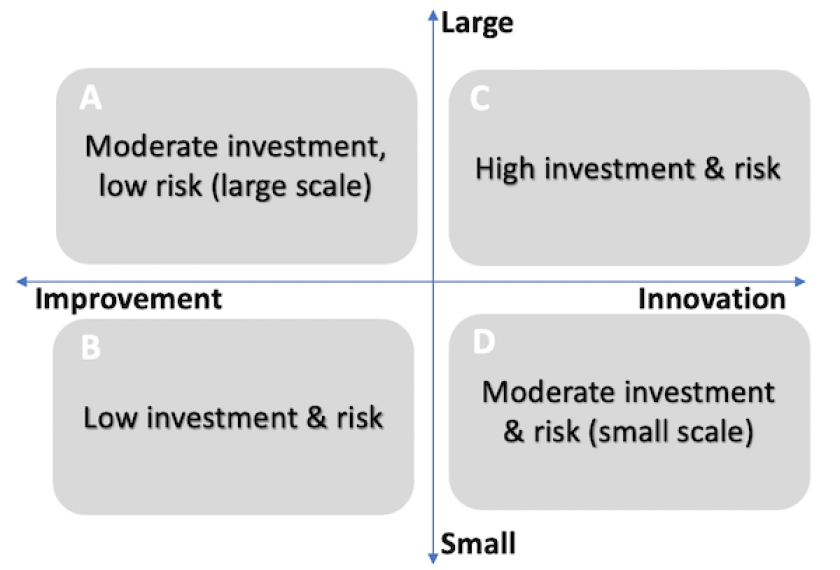
Is there really a difference between improvement and innovation?

• I make a clear distinction (in Wednesday's EdWeek blog) that innovation is improving the system we have while innovation is creating the system we need. The blog discusses 10 possible dimensions of innovation--all worth a faculty and community conversation discussion.

• It's important to try to introduce change in a school and system in the least disruptive way--that may involve a phase-out and phase-in strategy. Schools and districts also have to be thoughtful about their change capacity and balance execution (good teaching today) and innovation (better learning next year).

What about too much testing?

• With blended learning much of the assessment can move to the background and be imbedded into learning experiences. However, we need better competency-tracking systems to capture, synthesize, and report the flood of data.

• See Data Backpack: Portable Record & Learner Profiles for a full description. Utah recently implemented a portable record that will follow a student from school to school (SB82).

The state board is reconsidering graduation requirements in the next two weeks. What should they be requiring? (It's worth noting that the question and audience response showed strikingly low regard for current and planned standardized assessments)

• Bill Kurtz, DSST, gave a great answer: it should be high enough to give all students viable education and career options. Right now, requirements are below what the military requires.

• States should phase in Common Core expectations over the next three years using a minimum cuts score on new PARCC tests starting 2016.

What should a school or district do now?

• Open a couple flex schools fast to create options and show the community how a competency-based environment works. (See 10 Reasons Every District Should Open a Flex Model.)

How do we make sure schools keep the kids they have and don't dump problem kids on other schools?

• State policy that provides weighted, portable, and performance-based funding can partially address this problem (see Funding Students, Options & Performance.)

• Like NOLA, as Denver shifts to more of a portfolio of options, it will be important to have a community conversation about the desired level of coordination of transportation, enrollment, discipline, and facilities. (See yesterday's blog summarizing a portfolio chat in NOLA).

How do we recruit more teachers of color?

• Bill Kurtz said, "It starts with graduating more low income students of color from high school and college."

• We also have the opportunity to improve working conditions and career options ( see infographic, paper on this topic out 5/7)--and that should improve recruiting.

Van Schoales and his team at A+ created a great conversation hosted in the spectacular new Colorado History museum.

For more see Smart Cities: Denver's Advocates & Partnerships and Smart Cities: Early Observations (a summary of the portfolio strategy unfolding in Denver and other cities).

April 24, 2013

The High School Challenge: Improvement vs. Innovation

How to help more students graduate ready for college and careers? We're exploring the perennial question at the A+ Urban High School Summit in Denver.

The track record for high school improvement efforts isn't good--the disconnected string of courses is a bad model to start with. Best case scenario, some percentage of compliant well-supported kids play the game and go to selective colleges.

Compared to improvement efforts, new school development is more consistent in terms of results but it's not easy to start over. Most new schools still follow the traditional time-bound model but there are a few innovative student-centered networks--like Big Picture and Edvisions--that are competency-based flex models.

Improvement. Let's back up and define a couple terms. Improvement is doing things better. Innovation is doing things differently to dramatically improve outcomes. Nearly all high school reform efforts fall into the first category.

There are a set of best practices that have been around for 30 years that are still not widely implemented: high expectations across a college prep core curriculum with strong supports--as the Big Picture guys said, rigor, relevance, and relationships.

Improvement efforts usually leave the basic time-bound cohort-based structure in place and attempt to improve course offerings and course taking patterns; guidance services, academic supports and the quality of instruction. While not easy, these improvements can result in big system wide advancements in achievement and completion rates as seen in Cincinnati, New York City, and Kansas City, Kansas.

Innovation. Beyond these improvement efforts, the maturation of online learning and the mobile computing revolution are expanding the opportunity for innovation. Several philanthropic efforts have combined lessons and factors into new design principles:

  • Carnegie recently released 10 design principles in Opportunity by Design, the backbone of a new grantmaking initiative.
  • Providing guidance for the new round of Race to the Top, KnowledgeWorks released 10 Essential Elements of High School Reform & College and Career Readiness.
  • Next Generation Learning Challenges released a white paper last week outlining design principles and lessons learned in the first three waves of grants.

"The school and system level implications are pretty profound," said Robin Lake of the Center for Reinventing Public Education, about implementing Carnegie principles. All three of these design principles imply more innovation than improvement; they encourage us to

rethink the entire framework for high school, reconceptualize delivery, and reconsider connections to work, community, and higher education. There are at least 10 dimensions of innovation in these categories:

Frames

  1. Goals: Reconceptualizing the finish line may change mindsets and spark innovations. For example, the NYC 9-14 early college partnership with IBM results in an AA degree and a job. Why not a 9-14 code school with an app fund--students could graduate with $50k in cash rather than debt? How about using Big History as an Organizing Principle for a Compelling Block or School ?
  2. Time: Mobile learning devices extend the day and learning options to anywhere, anytime learning. With online learning, a school can travel with a team or band. (See 10 reasons every district should open a flex school. )
  3. Path: Digital learning can power multiple pathways for individual learners, including games/simulations, video explanations, projects and demonstrations. Knowledge map (like the math maps on Khan Academy) help students see where they are and where they are headed.
  4. Progress: Leaving behind courses and credits, innovative schools ask students to show what they know. Join the mastery-based learning community at CompetencyWorks. Imagine DIY High where accumulating 200 merit badges gets you a diploma--and a heck of a portfolio!

Delivery

  1. Personalization: Adaptive learning systems can diagnose learning levels and challenges and should be part of every K-8 week. Every secondary student should benefit from a blended guidance system that promotes college and career awareness. Every secondary student should receive personalized writing feedback every week (and that could include an automated scoring system).
  2. Pacing: Online learning allows the student to set the pace. What if we said, "Forget the 180 day window, failure is not an option, we're going to find a path and pace that works for you."
  3. Providers: As recommended by Digital Learning Now!, every student should have access to multiple full and part time providers--and that should include every AP course, any foreign language, and expertly taught high level STEM courses.

Connections

  1. Interests: Big Picture schools construct internships around student interests. There's a big group of students (at least 20%) that need and want an interest-based rather than content-based approach to learning. Online and competency-based learning make it possible to backfill around and support interest-based learning in new and interesting ways (see The Learning Design Opportunity of Our Time).
  2. Connections: From K to 12, students should spend an increasing amount of time in work and community based learning as they demonstrate preparation and responsibility.
  3. Pull: As noted in #1, reframing the deal may provide the hook for some students. The promise of scholarships, early admissions, or accelerated completion may boost achievement and completion.

Because I think boredom is a central problem in American high schools, at least half of these innovation domains deal with the issue of student motivation. They also imply a personalized set of supports, a comprehensive learner profile, and a much better achievement recognition system.

Like NewTechNetwork.org, all school networks will soon be platform-centric--they will share a set of tools that power a common framework, delivery strategy, and set of connections.

Powerful sustained adult relationships are central to both improvement and innovation agenda. The starting point has to be at least one person at school that cares if they attend, knows how they're doing, and cares about where they are headed.

The opinions expressed in Vander Ark on Innovation are strictly those of the author and do not reflect the opinions or endorsement of Editorial Projects in Education, or any of its publications.

Follow This Blog

Advertisement

Most Viewed
On Education Week

Recent Comments

Archives